
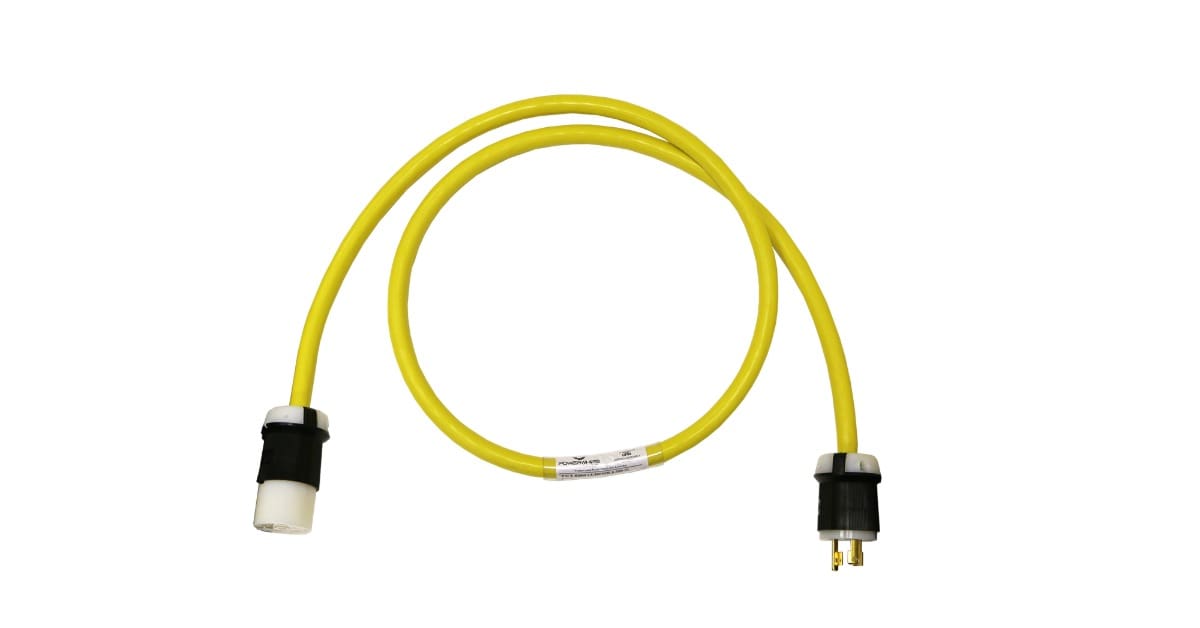
Engineers specify SOOW cable for demanding flexible-power applications because its construction addresses environmental and mechanical stresses that lighter-duty cords cannot handle. However, oil exposure can change polymer properties over time, while repeated surface contact can wear away jacket material and eventually compromise the cable.
These two hazards interact differently with the cord, so you should not evaluate them as though they share a single rating system. Read on as we explore SOOW oil and abrasion resistance ratings.
Explaining the SOOW Designation
Type SOOW falls in the extra-hard-usage flexible-cord category. The “S” identifies that service classification, and the cord carries a 600-volt type rating. The double “O” indicates that both the jacket and conductor insulation resist oil.
That double-layer oil resistance distinguishes SOOW from cord types with only oil-resistant outer jackets. If the jacket wears away, the insulation around each conductor still provides oil-resistant construction.
The final “W” signifies suitability for wet and outdoor conditions under the applicable cord requirements. Manufacturers typically mark SOOW products with water, weather, and sunlight resistance alongside the type designation, depending on the specific listing and construction.
The Double O Under Oil Exposure
Oil exposure changes the mechanical properties of polymeric cable compounds. Depending on the material and exposure conditions, the jacket may swell or soften. Prolonged incompatibility can also reduce tensile strength and compromise flexibility.
SOOW construction addresses that risk at two levels. Many manufacturers use ethylene propylene diene monomer (EPDM) around the conductors and chlorinated polyethylene (CPE) for the outer jacket.
Oil Resistant Does Not Mean Chemically Universal
Do not interpret oil resistance as unlimited chemical resistance. Hydraulic fluid, lubricating oil, cutting fluid, fuel, and process chemicals interact with polymers differently. Concentration and temperature also affect how materials respond.
For installations with sustained chemical exposure, use the SOOW marking as the starting qualification. Then, verify compatibility between the actual fluid and the cable compound the manufacturer uses. This additional check becomes essential when immersion or continuous saturation replaces occasional contact.
Understand the Oil-Resistance Markings
UL guidance distinguishes products evaluated for oil resistance at different temperatures. A product marked Oil Resistant I or Oil Res I undergoes evaluation for oil exposure at 60°C. Oil Resistant II or Oil Res II means the product was evaluated at 75°C.
Do not confuse these markings with the two “O” characters in SOOW. The double O designates which portions of the cord have oil-resistant construction. Oil Resistant I and II give additional information about the evaluated exposure temperature for those markings.
This distinction helps you compare cable products for environments where elevated temperature and oil exposure occur together.
Abrasion Resistance Functions Differently
SOOW does not use a separate letter to identify abrasion rating. Instead, the cord’s overall mechanical construction determines abrasion performance. The extra-hard-usage classification establishes the service category, while the jacket compound and finished design determine how the cord resists surface wear.
No universal SOOW value tells you how many dragging cycles the jacket will survive on concrete or how long it can tolerate contact with a particular machine edge.
For standard industrial use, an appropriately listed SOOW cord provides a robust jacket for demanding service. For severe mechanical exposure, evaluate how the specific jacket will interact with the installation.
CPE Jacket Construction Drives Mechanical Performance
Manufacturers commonly use CPE in industrial SOOW jackets because it provides a useful combination of flexibility and resistance to environmental exposure.
The jacket forms the first mechanical barrier between the cable core and the operating environment. Its compound formulation and thickness influence how the cord resists scraping and repeated movement.
However, specifying CPE alone does not fully define abrasion performance. Manufacturers formulate jacket compounds differently, and the complete cable construction influences mechanical behavior.
Cable diameter also affects how the cord moves through an installation. Larger conductor counts or heavier gauges create a larger assembly that can generate more contact force against routing surfaces.
Flexibility and Abrasion Resistance Need To Work Together
Portable power cable must tolerate movement without becoming mechanically rigid. A jacket designed only for hardness may not provide enough flexibility for repeated handling. Conversely, an extremely soft compound can perform poorly when the cable regularly contacts rough surfaces.
SOOW construction balances those requirements for extra-hard use, so you should consider the full service environment when selecting cable, not just maximize one material characteristic in isolation.
Oil and Abrasion Can Accelerate the Same Failure
Oil exposure and mechanical wear often occur together in industrial facilities. For example, you might route a SOOW assembly near equipment where lubricant reaches the cable surface. If the cable also moves against a structural edge during normal operation, the jacket experiences both chemical and mechanical stress at the same location.
The oil-resistant jacket maintains material properties under the intended exposure. Abrasion resistance preserves jacket thickness as the cable moves.
However, once abrasion creates a significant cut or worn area, the jacket cannot provide its original mechanical protection. The oil-resistant conductor insulation underneath adds another material defense, but you should not accept jacket damage.
Match the Cord to the Actual Exposure
SOOW gives engineers a recognized starting point for industrial flexible-power applications, but you must still review the application to ensure suitability.
Before approving a cable for a demanding installation, evaluate:
- Chemical exposure: Identify the actual oils or process fluids present.
- Exposure duration: Distinguish incidental contact from continuous saturation.
- Operating temperature: Confirm the cord rating under the expected conditions.
- Mechanical movement: Determine how often the cable flexes or relocates.
- Contact surfaces: Identify abrasion points before routing the cord.
- Bend conditions: Avoid forcing the cable into mechanically stressful paths.
- Cable construction: Verify conductor size and jacket compound.
- Product markings: Confirm listings and supplemental ratings on the finished cord.
This review provides a much stronger specification basis than simply selecting SOOW because the application appears industrial.
Use the SOOW Rating as a Specification Baseline
To interpret SOOW oil and abrasion resistance ratings effectively, separate what the designation explicitly indicates from what requires additional engineering judgment. SOOW construction delivers a durable platform for demanding mechanical service, but the designation does not translate into one universal abrasion-cycle number.
Electrol PowerWhips provides SOOW cable assemblies for applications that require flexible power distribution with durable cord construction. If oil exposure or mechanical wear affects your installation, start by reviewing the cable’s actual ratings and service conditions. Contact Electrol PowerWhips to discuss an SO power cord solution that meets your application’s electrical and environmental requirements.